If you are shopping for a home on Lake Ray Hubbard, it is easy to assume every “waterfront” listing offers the same experience. In reality, buying waterfront property in Rockwall and Heath can mean very different things depending on the shoreline, the city rules, and the long-term costs tied to the lot. This guide will help you understand what to verify before you buy so you can move forward with more clarity and confidence. Let’s dive in.
Rockwall and Heath are neighboring Lake Ray Hubbard markets, so buyers often search them together. That makes sense because both offer access to the same lake, but the pricing and property profiles can be very different.
In March 2026, Rockwall had a median sale price of $484,000, while Heath’s median sale price was $765,000. Waterfront inventory also showed a notable spread, with Rockwall waterfront listings at a median listing price of $535,000 and Heath waterfront listings at a median listing price of $849,000.
That gap matters when you begin comparing homes that may look similar online. In many cases, the difference comes down to lot size, shoreline frontage, improvement potential, and the condition or legality of features such as docks, seawalls, and boathouses.
One of the most important steps in your search is understanding how the property is classified. A lake-view home, a lake-access home, and a true waterfront or shoreline lot are not the same thing, even if the listing language sounds similar.
A lake-view home may offer strong visual appeal without direct shoreline rights. A lake-access property may provide a path or nearby connection to the lake, while a true waterfront lot may involve direct shoreline and a more complex set of rules about what can be built or maintained.
On Lake Ray Hubbard, direct shoreline often brings additional regulation. That means the real value of a waterfront home is not just the view. It is also tied to what you can legally do with the shoreline.
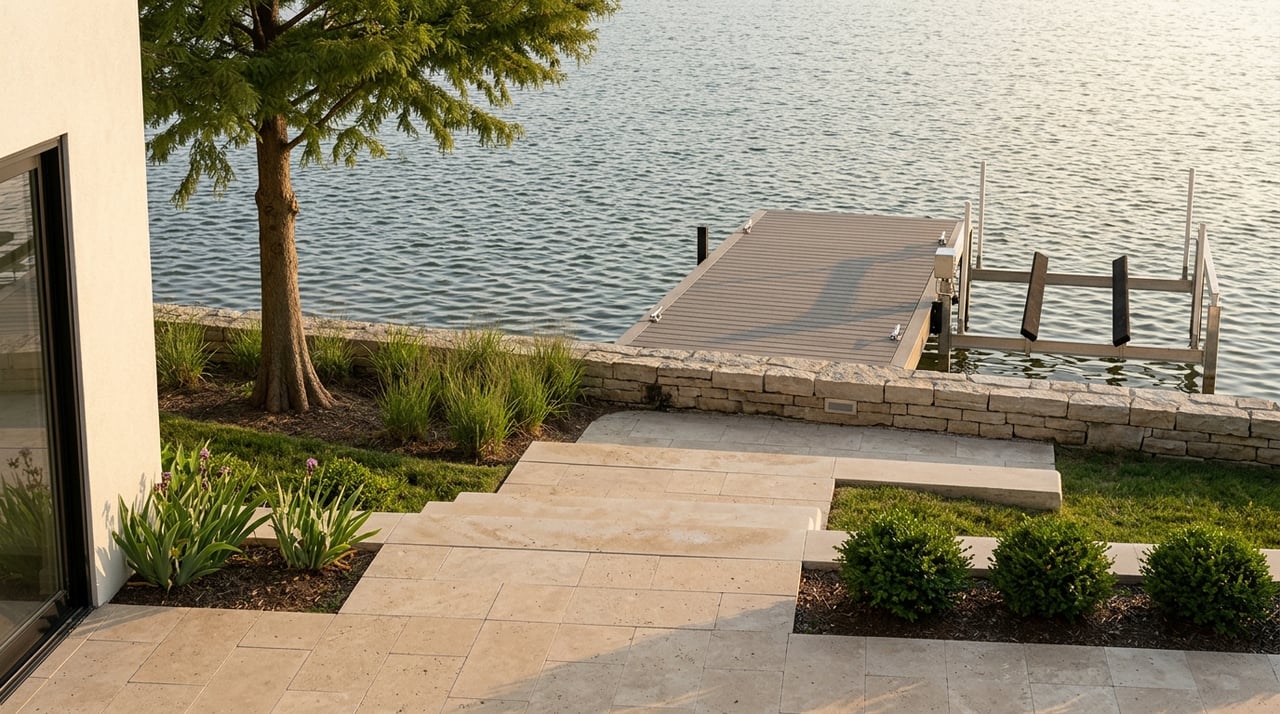
If you are considering a direct-water property in Rockwall, shoreline improvements deserve close review. The City of Rockwall’s Takeline Ordinance regulates shoreline development.
According to the city, boat-related structures require a seawall permit first. The city also requires a sealed structural engineer design and a post-set survey for those improvements.
That means a dock, lift, or other lake-related feature should never be treated as a simple add-on. Before you buy, you will want to confirm whether improvements were properly permitted and whether future changes may require additional approvals.
Heath has its own lake-edge ordinance, and the details are especially important for waterfront buyers. The city uses 435.5 feet mean sea level as the normal pool elevation reference and sets different rules based on the amount of shoreline frontage tied to the parcel.
For parcels with 75 or more linear feet of shoreline, one boathouse may be allowed and, in some cases, a dock deck or fixed pier may also be allowed. For parcels under 75 linear feet, a boathouse or dock deck is not allowed.
Heath’s ordinance also addresses design and material standards. Rules cover items such as catwalk and deck materials, engineered pilings, roof pitch, overhangs, and exterior finish standards that are intended to match the primary home.
For buyers, the takeaway is simple. In Heath, waterfront value is closely tied to what the shoreline legally supports, not just how the property looks from the backyard.
Lake Ray Hubbard shoreline issues can involve more than the local city. Dallas’s lake-shore code defines lake shore as city-owned land surrounding the lake and states that no structure may be built, used, or maintained there without express written authority from the Dallas Water Utilities director.
Heath’s permit materials also state that requests to alter or construct on Lake Ray Hubbard and surrounding City of Dallas property need concurrence from both Dallas Water Utilities and the local city. This adds another layer of review for some direct-water properties.
If a home has an existing dock, seawall, boathouse, or similar feature, you should ask whether those improvements were approved and whether any future work would need fresh authorization. This is one of the most important due-diligence questions in a waterfront purchase.
Many buyers are surprised by this part. Even if you own a waterfront lot, the water itself is still subject to public-water rules.
Texas Parks and Wildlife states that if a lake is public water, then all of the lake is public water, including the water around marinas and boat docks. The right to build or operate a dock does not give an owner the right to restrict boating or fishing from a boat in that area.
This matters because buyers sometimes assume a private dock creates exclusive lake use. In practice, dock ownership, boating access, and public-water rights are separate issues, and you should evaluate them that way.
If you plan to keep a boat on the property, it helps to understand a few basic Texas rules before you buy. Texas requires registration for motorized vessels and for nonmotorized vessels that are 14 feet and longer on public water.
Texas also requires boaters leaving or approaching public fresh water to drain all water from vessels and onboard receptacles to help prevent zebra mussels. While these may sound like small details, they can affect how you plan to use the property day to day.
If the seller keeps a boat on-site, it is smart to confirm lift rules, slip setup, and any neighborhood or shoreline restrictions that may affect storage or use. A waterfront home works best when the lifestyle fits the rules as well as the view.
Waterfront buyers often focus on the purchase price first, but the carrying costs can vary widely from one property to another. In Texas, homeowners associations may regulate items such as docks, exterior changes, rentals, and access through their governing documents.
Under Texas Property Code Chapter 207, a resale certificate must include the current restrictions, bylaws, rules, and a summary of assessments and transfer restraints. Associations may also charge a fee to prepare that certificate.
Beyond HOA costs, you should also look for special district obligations. The Texas Comptroller notes that local governments and special districts can levy property taxes, and special-purpose districts may be funded through property taxes, user fees, debt, and other mechanisms.
This is where parcel-by-parcel review becomes important. Two waterfront homes on the same lake may have very different annual costs if one is located in an HOA-only subdivision and another is subject to a PID or MUD structure.
Another key part of buying waterfront property in Rockwall and Heath is understanding flood risk. Standard homeowners insurance generally does not cover flood damage.
FEMA’s flood maps are the official source for flood-zone information. FEMA also states that federally regulated or insured lenders require flood insurance for buildings in a Special Flood Hazard Area when the loan is federally backed.
Flood-insurance pricing can vary based on factors such as the amount and type of coverage, the flood zone, and the building’s design and age. In higher-risk areas, elevation relative to base flood elevation can also affect pricing.
For that reason, it is often helpful to ask whether an elevation certificate already exists for a direct-water property. That document can provide more clarity when you are evaluating insurance and lender requirements.
Not all waterfront homes are priced the same for the same reasons. On Lake Ray Hubbard, value is often shaped by frontage length, the quality of the view, shoreline usability, dock or boathouse potential, engineering condition, and whether the lot offers practical outdoor living space.
That helps explain why current pricing can vary so much between Rockwall and Heath. The city name matters, but the property itself often matters more.
A home with direct shoreline is not automatically the better buy if the improvements are limited, the flood exposure is higher, or the carrying costs are heavier than expected. The strongest purchase is usually the one where the legal use, monthly budget, and lifestyle goals all line up.
Before you move forward on a waterfront home, make sure you review the basics carefully:
This kind of review can save you time, money, and stress later. It also gives you a much clearer picture of what you are really buying.
Buying waterfront property in Rockwall and Heath can be incredibly rewarding, but it is rarely a simple plug-and-play purchase. The home, the lot, the shoreline, the permit history, and the carrying costs all need to work together.
If you approach the process with the right questions, you can avoid surprises and focus on the properties that truly fit your goals. Waterfront living is at its best when the beauty of the setting is backed by solid due diligence and a plan that makes sense for your lifestyle.
If you are weighing waterfront options around Lake Ray Hubbard, the right guidance can make the search feel much more manageable. The J.Klefeker Group offers a relationship-first, white-glove approach that helps you evaluate the details with confidence and move forward with a clear strategy.